Facility Document Digitization
Your building records are scattered across paper rolls, binders, old PDFs, and city files, and nobody can find the right drawing when it matters.
Turnkey digitization of scattered building records — paper blueprints, old PDFs, permit files, MEP diagrams — into a structured, searchable digital archive. Your team finds any document in seconds.
You send
- A rough inventory: paper rolls, binders, PDFs, shared drives
- Access to the storage rooms or file servers
- The folder structure or CMMS fields your team needs
- Which buildings or systems come first
You receive
- Indexed digital archive (structured folders + metadata)
- Document gap analysis report
- City permit research and file retrieval
- Searchable, multi-page PDF/A archives for long-term document retention
- Structured metadata index (CSV/Excel) mapped to CMMS requirements
- High-resolution TIFF files for archival blueprints and wide-format drawings
- Optional IDA custom RAG deployment for plain-language search capabilities
Timeline depends on
- Number of sheets and pages, and their condition
- Wide-format drawings that need large-format scanning
- Permit records that must be requested from the city
- Confirmed in the written scope before you commit
We research, collect, and organize scattered building records into a structured, searchable digital archive. Your team finds any document in seconds instead of digging through storage rooms.
Most facilities run on incomplete, scattered records: paper blueprints in a basement, scanned PDFs with no naming convention, permit files at the city, MEP diagrams in a former contractor’s email. When someone needs the current electrical riser or the approved fire-life-safety plan, the search costs hours — or the document is simply never found, and work proceeds on a guess.
FieldScan turns that mess into an asset.
The IDA flagship: from archive to answers
A digitized archive is useful. An archive you can ask questions of is transformative. That’s IDA — Intelligent Document Archive, our flagship product.
IDA layers an AI-powered retrieval system on top of your digitized records. Instead of navigating folders, your facilities team asks in plain language — “where’s the most recent roof warranty for the north building?” — and IDA returns the actual document, with the relevant section surfaced. It’s the difference between a filing cabinet and a colleague who has read every file and never forgets where anything is.
IDA operations are entirely AI-assisted with human verification. While high-volume document scanners and AI-powered OCR extract structured metadata, the final index is manually reviewed. When a facility manager searches for a critical electrical riser diagram, the retrieval system queries validated data rather than relying on unsupervised AI categorization.
How an engagement runs
- Gap analysis. We inventory what records exist, flag what’s missing or duplicated, and identify which missing documents can be recovered from city files. You get a clear report of your true document position before anything is scanned.
- City permit research and retrieval. Building permits, approved plans, and inspection records are frequently on file with the local jurisdiction even when the owner’s copies are gone. We pull them.
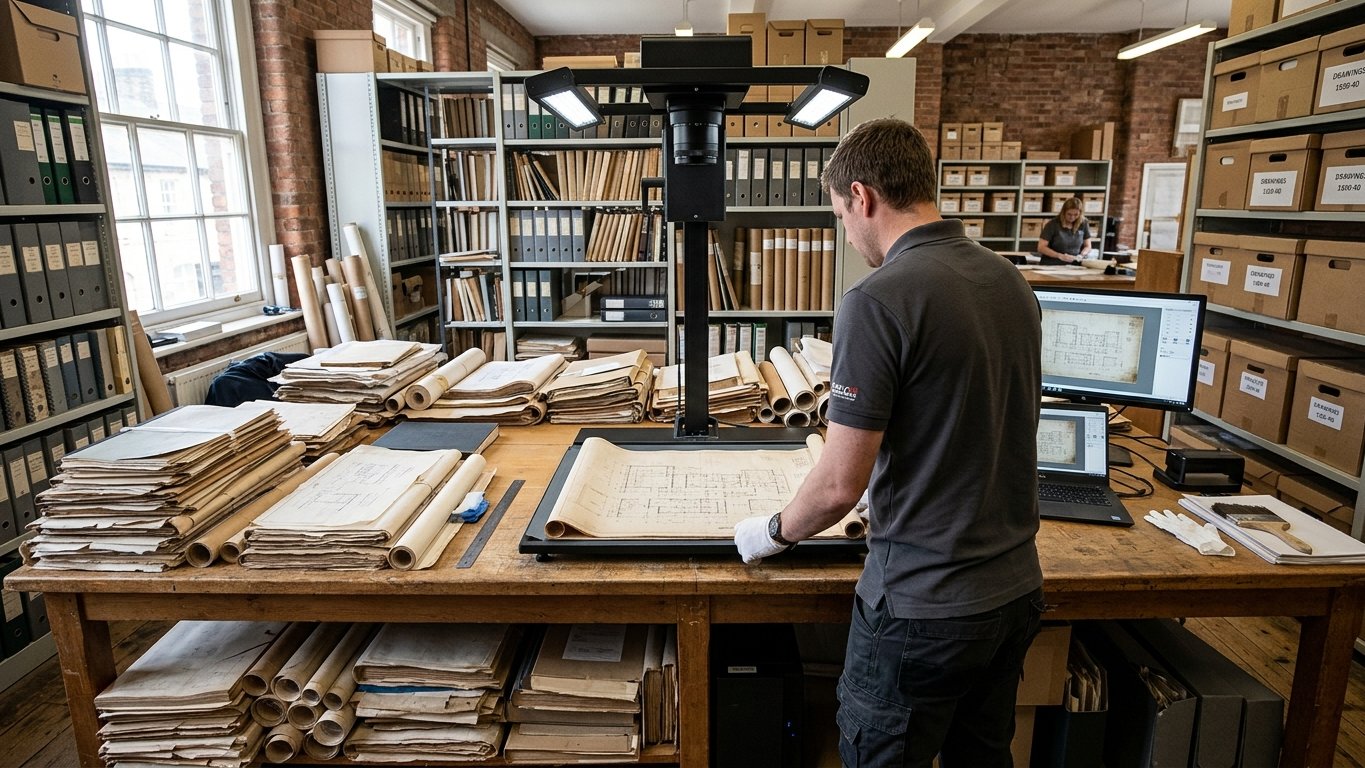
- Digitization and indexing. High-volume scanning, AI-assisted OCR, and structured metadata extraction produce a clean, consistently named, searchable archive — organized to a folder and metadata schema that fits how your team actually works.
- Optional IDA layer. For facilities that want plain-language retrieval, we deploy the IDA search system on top of the indexed archive.
Who this is for
Facility document digitization pays off most for organizations carrying large or aging building portfolios: hospitals and healthcare campuses, universities, municipal and institutional owners, industrial sites, and property managers responsible for many buildings at once. Anywhere the cost of not finding a document is measured in delayed work, failed inspections, or repeated site visits, a structured archive earns its keep quickly.
In Southern California, organized records support sectors with stringent compliance and retrofitting cycles. Sorrento Valley biotech labs undergoing tenant improvements, Orange County healthcare campuses managing HCAI compliance, and municipal facilities across the Inland Empire require access to historical as-builts. If a contractor encounters an undocumented post-tension cable because the structural revision was lost in a basement box, the resulting delay directly impacts the broader project schedule.
Security and confidentiality
Facility records frequently include security-sensitive information — floor plans, access points, utility and MEP layouts. The digitized archive and any IDA layer are delivered under the access controls you specify, and we treat all underlying documents as confidential throughout. We align the delivery and hosting model with your organization’s data-handling requirements during scoping.
Pairs naturally with scanning
A digitized document archive answers “what was designed and permitted.” A 3D laser scan answers “what is actually there now.” Together they give a facilities team both the historical record and the verified current condition — the complete picture for renovation, maintenance, and long-term asset management.
Talk to us about your facility’s records and we’ll start with a gap analysis.
Combining structured historical records with verified current conditions provides a comprehensive baseline for facility management. By linking digitized O&M manuals, warranties, and MEP submittals to structural elements within a Scan-to-BIM Revit model or Navisworks federated model, facility managers gain integrated access to both design intent and as-built geometry. Whether for a life science facility or a municipal campus, this dual approach aligns historical documentation with the physical site.