Drone Surveying & Inspection
You need current site conditions, earthwork volumes, or roof and facade condition without scaffolding, lifts, or days of ground survey.
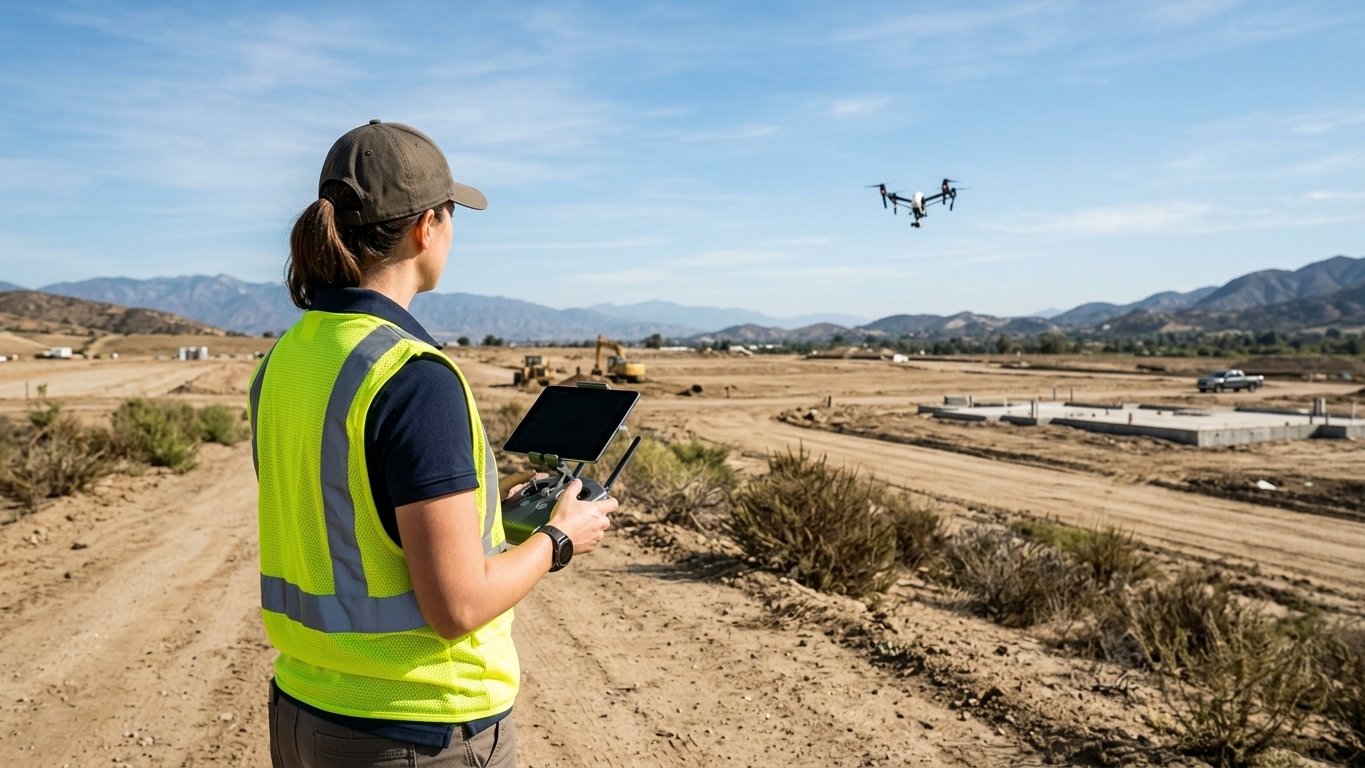
FAA Part 107 aerial operations for site mapping, roof and facade inspections, earthwork volumetrics, and construction progress documentation. Georeferenced orthomosaics and 3D terrain models — no scaffolding, lifts, or site disruption.
You send
- Site address and the area to fly: a sketch, KML, or parcel number
- What you need: orthomosaic, surface model, volumes, or inspection report
- Coordinate system and datum your team works in
- An on-site contact and any site safety rules
You receive
- Georeferenced orthomosaic maps
- 3D terrain models and digital elevation models
- Annotated inspection reports (roofs, facades)
- Volumetric calculations for earthwork and stockpiles
- High-density photogrammetric point clouds (LAS/LAZ format)
- 3D textured mesh models (OBJ/FBX formats) for conceptual visualization
- AutoCAD Civil 3D compatible surface models (DWG)
Timeline depends on
- Airspace near airports needs FAA authorization before the flight
- Wind, rain, and marine layer can move the flight day
- Site size and the required ground resolution
- Confirmed in the written scope before you commit
FieldScan operates FAA Part 107-compliant drones for aerial mapping, inspection, and progress documentation across San Diego County and Southern California. Drones reach what a tripod scanner or a ground crew can’t do efficiently — rooftops, large sites, active construction, steep terrain — and they do it without lifts, scaffolding, or shutting down the site.
What drone surveying delivers
Site mapping and topography. A flight produces a georeferenced orthomosaic and a 3D terrain model of an entire site in a single mobilization. With RTK ground control, the data is accurate enough for earthwork planning, drainage analysis, and site design coordination.
Earthwork and stockpile volumetrics. Drone-derived surface models let us calculate cut, fill, and stockpile volumes far faster and more safely than walking a site with a rod. Recurring flights track how volumes change over a project’s life.
Roof and facade inspection. High-resolution imagery of roofs, parapets, and building facades — captured without putting anyone at height. The deliverable is an annotated report with georeferenced imagery, so a facility manager or contractor can locate every flagged condition precisely.
Construction progress documentation. Scheduled flights create a time-stamped visual and dimensional record of how a project is advancing — useful for owner reporting, schedule verification, and dispute documentation.
Where drones fit (and where they don’t)
Drones are the right tool for exteriors, sites, roofs, and large areas. They are not a substitute for a legal boundary survey or for millimeter-grade interior as-builts. FieldScan’s advantage is that we run drones alongside laser scanning and ground survey, so we recommend the method your accuracy requirement actually needs rather than selling you the one tool we happen to own.
A common combined workflow: drone for the site and roof, laser scanning for the interior, ground control tying both into one coordinate system. The client gets a single coherent dataset instead of three disconnected deliverables.
Airspace and compliance
Much of San Diego County is controlled airspace. Operations near San Diego International, Montgomery-Gibbs, McClellan-Palomar, and Brown Field require LAANC authorization or a manual FAA waiver before takeoff. We handle that clearance during planning. It is part of the job, not an afterthought — flying without it is both illegal and uninsurable.
Pricing context
Drone work is priced by site size, deliverable type, and whether the engagement is one-time or recurring. A single-day mapping flight with a standard orthomosaic and terrain model is the entry point; volumetric reporting, inspection annotation, and recurring progress flights scope on top. Recurring construction-progress programs are typically set at a fixed per-flight rate.
What you receive
- Georeferenced orthomosaic maps
- 3D terrain models and digital elevation models
- Volumetric calculations for earthwork and stockpiles
- Annotated inspection reports for roofs and facades
- Raw imagery on request for your own downstream processing
Related services
Drone surveying pairs naturally with 3D laser scanning for projects that need both exterior and interior capture, and feeds land surveying workflows where a stamped deliverable is required — including an ALTA/NSPS survey for commercial real estate transactions. Tell us about your site and we’ll recommend the right capture method.