3D Laser Scanning
Your existing drawings don't match the building, and tape measurements miss what sits above ceilings, behind equipment, and between floors.
We capture existing conditions with survey-grade 3D laser scanners, producing high-density point clouds accurate to ±2mm. The foundation for BIM modeling, renovation planning, MEP coordination, and facility management.
You send
- Site address and an on-site access contact
- Which floors, rooms, roof or exterior areas to capture
- Existing drawings or old surveys, if you have them
- Required accuracy, file formats, and the software your team uses
- The date the data is needed by
You receive
- Registered point cloud (.rcp, .e57, .las)
- Registration report documenting achieved accuracy
- Orthophotos and elevations
- TruView / scan navigator deliverable
- Optional: 2D floor plans from scan data
Timeline depends on
- Floor area, scan density, and how many areas must be captured
- Access windows: occupied spaces, tenant hours, active construction
- Whether registration only or full modeling follows the scan
- Confirmed in the written scope before you commit
3D laser scanning captures the existing conditions of a building or site as a dense, measurable point cloud — millions of survey-grade points, each with a real-world XYZ coordinate. It replaces tape measures, hand sketches, and guesswork with a verified digital record of what is actually there, accurate to within a few millimeters.
FieldScan operates Leica RTC360 and BLK360 scanners across San Diego County and Southern California. We deliver the registered point cloud plus whatever downstream format your team works in — Revit-ready data, 2D plans, TruView for in-browser navigation. The scan is the foundation; everything else builds on it.
When laser scanning is the right tool
Scanning earns its budget whenever the cost of being wrong about existing conditions is high:
Renovations and tenant improvements. Original drawings are almost never accurate after years of changes. A scan gives the design team verified slab elevations, column locations, ceiling heights, and MEP routing — so design decisions rest on field reality, not on drawings that no longer match the building. We support architects and design firms with registered point clouds aligned to project coordinates, eliminating return trips with tape measures before schematic design starts.
MEP coordination and clash avoidance. A registered scan lets engineers route new systems against actual as-built geometry. Clashes get caught in the model instead of in the field, where they cost real money and schedule.
Heritage and adaptive reuse. Historic structures often have no digital record at all. A scan creates one. San Diego’s historic districts — Gaslamp Quarter, Sherman Heights, Burlingame — see this regularly, often as the first step before any permit application.
Litigation, insurance, and dispute documentation. A scan is a time-stamped, measurable record of conditions on a specific date. That is hard to argue with.
How a FieldScan project runs
- Scope call. We confirm what you need the scan for — because the end use sets the scan density, the registration tolerance, and the deliverable format. Scanning for a feasibility study is not the same job as scanning for MEP prefabrication.
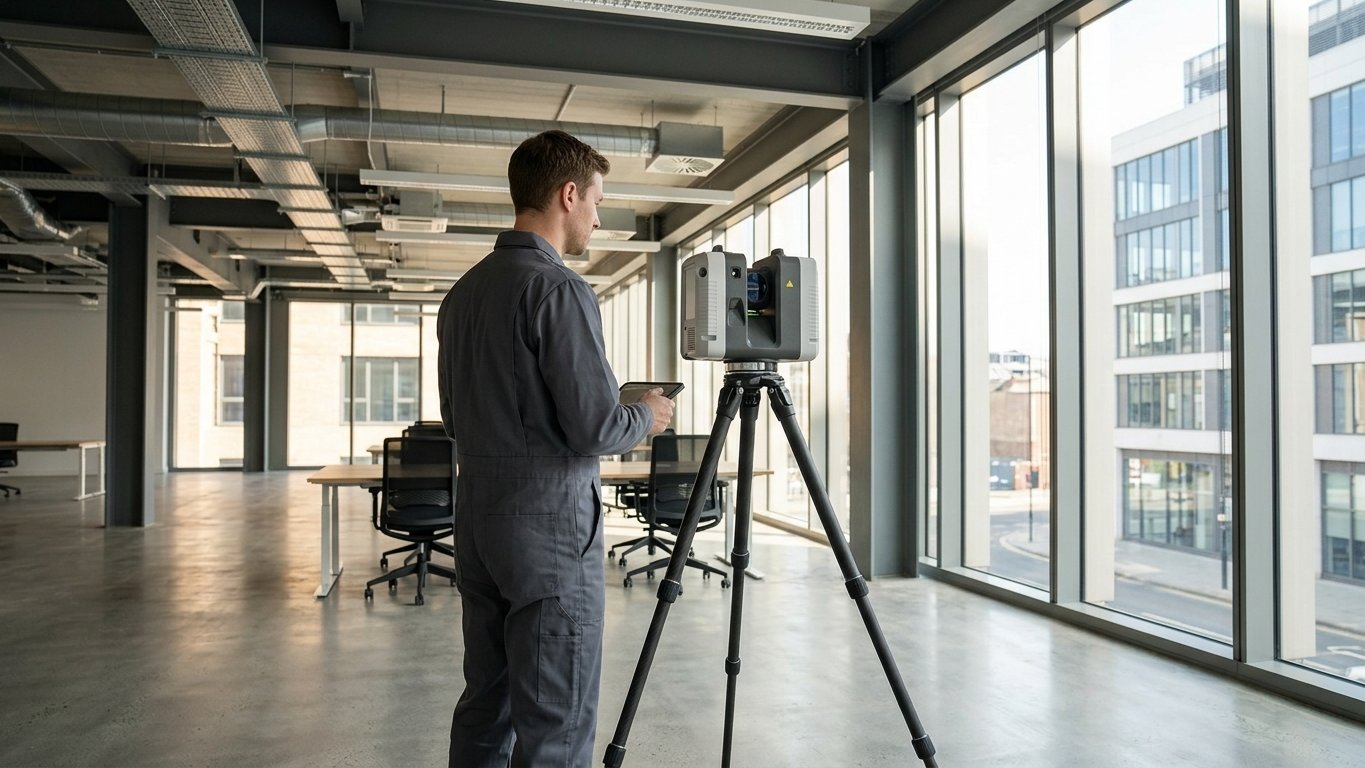
- Field capture. Tripod-mounted scanning, position by position. Per-position capture is 1–3 minutes on the RTC360. We place targets or use cloud-to-cloud registration depending on site conditions.
- Registration. Individual scan positions are aligned into a single coordinate system. We deliver a registration report documenting the achieved accuracy — no hand-waving about “survey grade.”
- Deliverable production. Point cloud in your format, plus any extracted 2D or 3D products you scoped.
- Handoff. We confirm the data opens cleanly in your software before we call the job done.
Accuracy, honestly stated
The RTC360 delivers ±2 mm range accuracy at 10 meters. After registering multiple scan positions across a project, a well-controlled point cloud typically holds ±3–5 mm across the whole registered set. We report the actual achieved figure per project rather than quoting a single brochure number, because real-world accuracy depends on site geometry, target placement, and project size.
Pricing context
Laser scanning is priced primarily by building size, complexity, and required deliverables — not by hours. A single-story commercial space of around 10,000 sq ft is typically one day of fieldwork plus several days of registration and deliverable production. Multi-story or MEP-dense facilities scale from there.
We quote fixed-fee once scope is confirmed. If you only need the raw registered point cloud, that is the lowest-cost option; extracted 2D plans, BIM modeling, and TruView deliverables are scoped on top.
What you receive
- Registered point cloud in your preferred format (.rcp, .e57, .las)
- A registration report documenting achieved accuracy
- TruView or an equivalent scan navigator for in-browser review
- Optional extracted 2D floor plans, sections, and elevations
- Optional handoff into scan-to-BIM if you need a Revit model rather than raw scan data
3D laser scanning across San Diego County
FieldScan runs laser scanning throughout San Diego County, with projects across Orange County, Riverside County, and the Inland Empire. Point-cloud capture is the same instrument-grade process wherever the site is; what changes locally is context.
Public LiDAR — the regional datasets published through SanGIS / SANDAG and county programs — is a useful reference for terrain and rough site extent, but its ground sample distance is measured in points per square meter, not the millimeters a renovation or MEP model needs. Where a design decision rests on a slab elevation, a beam soffit, or a duct run, terrestrial scanning is the tool that actually resolves it.
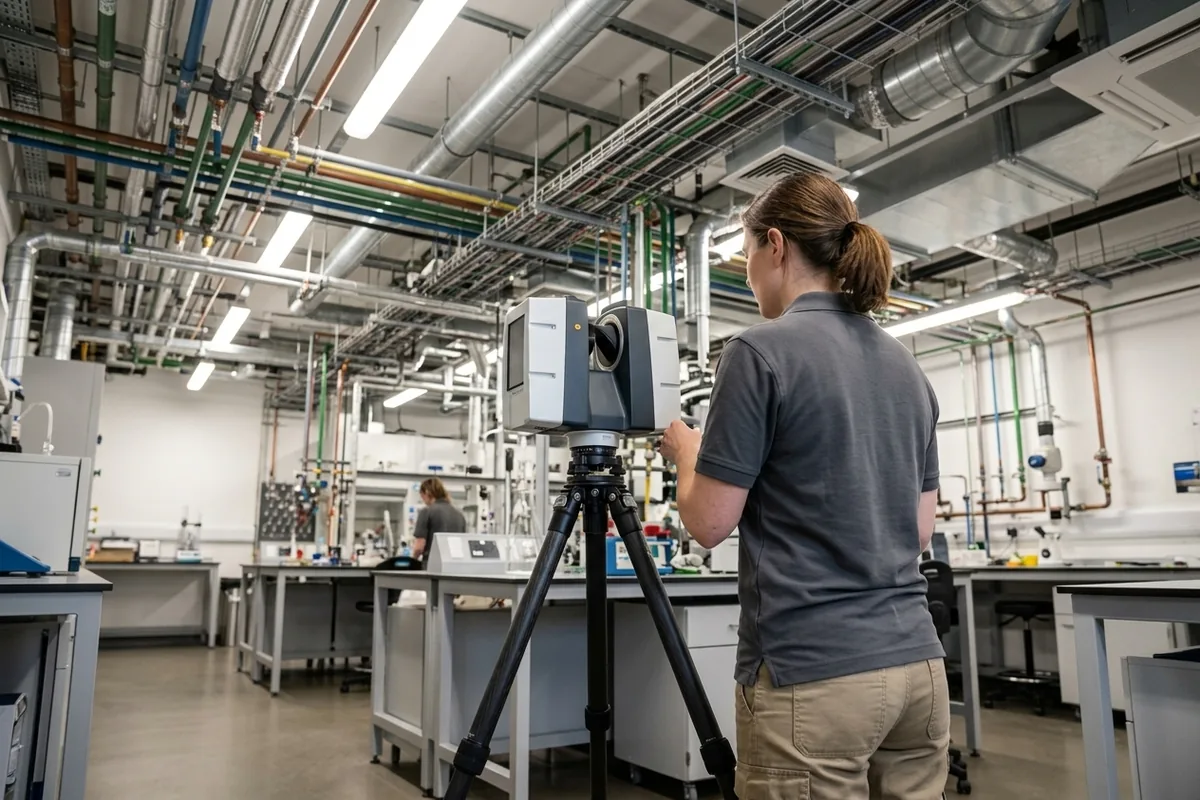
The demand here is specific. Tenant-improvement fit-outs in Sorrento Valley lab and biotech space are MEP-dense, and a fit-out’s feasibility often turns on verified existing conditions. Campus and institutional facilities are frequently built in phases and never fully documented. And the region’s ADU and adaptive-reuse permits increasingly call for drawings that match the building as it stands, not as it was drawn decades ago. Laser scanning answers all three. For facilities where the paper trail itself is missing or scattered, our Facility Document Digitization service recovers and indexes whatever records still exist before we scan.
Choosing scanner, drone, or total station
Good capture starts broad, then narrows to the instrument the deliverable actually justifies. A robotic total station places a handful of highly accurate discrete points — right for setting control or checking one critical dimension, wrong for capturing a whole room. Terrestrial laser scanning captures everything in line of sight as a dense cloud, which is what a BIM model or a clash-detection workflow needs. For roofs, facades, and site exteriors a tripod can’t reach efficiently, FAA Part 107 compliant drone surveying — photogrammetry for visual and site context, LiDAR where vegetation or bare-earth terrain demands it — covers the rest.
The same judgment applies to how much model you buy from the scan. A scan can support anything from LOD 200 massing to an LOD 500 verified as-built, but paying for connection-level LOD 350 or 400 across an entire building is the most common way to waste budget. Match the level to the decision each element supports — the BIMForum LOD Specification and our BIM LOD levels guide walk through where each level earns its cost. For heritage and adaptive-reuse work, capture targets shift again toward documentation standards such as HABS and FADGI rather than modeling LOD.
Related services
Most scanning engagements are the first stage of a larger workflow. Scan-to-BIM converts the point cloud into a usable Revit model. Drone surveying covers the exterior, roof, and site that a tripod scanner can’t reach efficiently. For projects that need a stamped survey, our land surveying service works through a licensed California PLS.
Tell us what you’re building and we’ll tell you exactly what to scan and in what order. Get a scope and quote.